
2025 PRB Annual Report

In 2025, we continued working toward a world where leaders, advocates, and communities use demographic evidence to know who they serve, anticipate what’s coming, and act so that everyone can thrive.
Continue scrolling to learn more about how this historic year took shape.
A Message From Jennifer D. Sciubba, President & CEO
Our Work Made Headlines
PRB In The Public Conversation
When demographic issues became political flashpoints, our experts were there—not scrambling to respond, but positioned as credible, nonpartisan voices ready to temper the debate. PRB staff appeared in flagship media, international broadcasts, and scholarly venues as leading voices, bringing demographic evidence and nuance into important conversations across the globe.
Select Interviews
Click the button below to access the full article.
Click the button below to access the full segment.
Click the button below to access the full segment.
Click the button below to access the full article.
Click the button below to access the full article.
Click the button below to access the full article.
Click the button below to access the full article.
Click the button below to access the full article.
Click the button below to access the full article.
Click the button below to access the full segment.
Answering the Call
Agility Under Pressure
The January 2025 funding shock did not halt PRB’s work—instead, it redirected our energy. Staff quickly developed new work practices and pursued new opportunities with urgency. We submitted a record number of funding proposals, securing new partnerships and projects — nearly half from funders new to PRB. Thanks to a strong network of supporters, we also launched our first-ever matching campaign of $30,000 and surpassed our Giving Tuesday fundraising goal.
The breadth and quality of the work in this report is a testament to our phenomenal team, enduring expertise, and valuable collaboration. We’re also grateful to our Board of Trustees, chaired by Bobby Jefferson, for their unwavering confidence and support during an intense period. This year showed what becomes possible when that support is there, and what is at stake when it isn’t. Continued investment remains essential.
Meeting the Moment
In 2025, three challenges demanded action, not just observation or commentary. In each case, PRB moved quickly and deliberately—in close coordination with partners and funders—because we had already laid the groundwork.
1) Safeguarding Public Data
The integrity of the U.S. federal statistical system — and of essential global demographic data programs —faced serious threats in 2025. PRB did not wait to see how events unfolded, but rose to meet the moment by creating communities focused on progress.
Charting the Future of the Demographic and Health Surveys
In February, the U.S. government abruptly ended its support for the Demographic and Health Surveys program—a resource that had supported more than 400 surveys in over 90 countries since 1984. The DHS is among the most consequential sources of population and health data for low- and middle-income countries, and its termination was one of the most significant data losses of the year.
PRB acted quickly to organize a virtual global convening on May 7-8 that brought together leaders from national statistical offices, donor organizations, partner organizations, and data user groups across countries served by the DHS. The meeting identified priorities for collaboration, assessed what data could still be protected, and began mapping a path forward. The resulting report became a reference for the broader field’s response and a guide for future responses.
Launching the Federal Data Forum
When threats to the U.S. federal statistical system began to emerge, PRB knew that data users across the country needed a trusted source of information and infrastructure. In May, PRB partnered with the Massive Data Institute to launch the Federal Data Forum: a free, open community for researchers, planners, and advocates. Moderated by PRB experts, the forum helps over 1,000 data users across all 50 states, the District of Columbia, and Puerto Rico track developments, share concerns, ask questions, and coordinate responses to changes in federal data quality and availability.
PRB also partnered with the Association of Public Data Users, Dataindex.us, and other advocacy organizations to host rapid-response briefings, helping data users track developments and respond to proposed changes to major federal datasets and surveys.
2) Setting the Agenda on Fertility, Rights, and Reproductive Choice
Reproductive health, particularly low fertility and its societal effects, was a hot topic in 2025. PRB brought facts to a divisive public discourse, delivering data and evidence to policymakers, the media, and the broader public.
Introducing State of Access: A Contraceptive Policy Scorecard
PRB released the State of Access scorecard, a comprehensive, nonpartisan tool that assesses the policy environment for contraceptive access in each U.S. state and the District of Columbia. Funded by Arnold Ventures, the scorecard illuminates where access to contraception is protected or restricted through laws affecting affordability, availability, and environment of care. It found that 16 states—home to 35% of Americans—actively restrict access to contraceptives through policy.
Designed as a blueprint for action, the scorecard helps advocates, researchers, journalists, policymakers, and communities identify where protections exist and where additional action is needed. The scorecard was developed with guidance from a panel of experts, including physicians and researchers, and was accompanied by targeted outreach to policymakers, journalists, and advocates to maximize its visibility and impact.
The scorecard generated extensive media coverage, including mentions in NBC, NPR, and Axios. In its first two months, it reached an estimated 4.1 million people through print and broadcast coverage. More than 300 people attended the launch webinar, which focused on how policymakers, advocates, and researchers can use the tool in their work. Texas added the scorecard to its Legislative Research Library—a notable indication that the tool is informing policy discussions. In November 2025, the scorecard won a silver Anthem Award for Best Use of Data in the Health category.
Protecting Health and Rights as Fertility Rates Decline
With support from the David and Lucile Packard Foundation, PRB partnered with EngenderHealth to launch Protecting SRHR in the Context of Fertility Decline, a pilot initiative examining how one of the defining demographic narratives of our time—concern over declining fertility—is reshaping public discourse, policy agendas, and funding priorities for sexual and reproductive health and rights (SRHR).
Working across Côte d’Ivoire, Ethiopia, Nigeria, and Tanzania, the project engages government leaders, health experts, journalists, civil society organizations, and community groups to understand how growing anxiety about fertility decline is influencing support for reproductive health and rights. The project will translate this information into action, developing evidence-based messaging guidance, plus training and resources for journalists and other media stakeholders. By shaping the narrative before it crystallizes into policy, the initiative seeks to safeguard progress on SRHR and protect access to essential reproductive health services in a rapidly changing global landscape.
The Smaller World Webinar Series
In 2025, PRB kicked off the Smaller World webinar series—four events exploring the implications of lower fertility across family planning and reproductive health, the future of work, depopulation and resilience, and national security. On June 26, the first event, “Challenging the Low-Fertility Panic: A New Narrative for Reproductive Health,” brought together an international, multisectoral panel, including experts from Fòs Feminista, EngenderHealth, UNFPA, the Population Foundation of India, the African Population and Health Research Center, and the New York Times. Over 1,000 people from more than 80 countries registered to attend.
We kept the conversation going, releasing a follow-up article answering audience questions and a media guide. Beyond the Headlines: What’s Really Happening With Global Fertility unpacks the evidence behind falling fertility rates, corrects common assumptions, and offers practical framing for reporters covering the topic.
3) Saving the World Population Data Sheet
Every year for six decades, PRB has released the World Population Data Sheet—a trusted, independently curated snapshot of global population data used in classrooms, cited in policy testimony, and relied upon by researchers and journalists across the globe. But the public funding cuts that dismantled USAID in January eliminated funding for the 2025 edition, resulting in the first publication gap since 1962.
Our community did not stay silent, responding quickly and personally. Stories poured in from around the world about what the World Population Data Sheet had made possible and what its absence would mean.
I have used the data sheets in my classes for over 10 years. They have been an amazing source of reliable data for my students to use and get a real sense of the contrasts that exist in the world. They have been really useful to turn students who are daunted by massive datasets into students who love working with data.
James Baggaley, Teacher of Geography, United Kingdom
Those stories became the foundation of a fundraising effort. Rather than quietly absorbing the loss, PRB made the case that the Data Sheet was too important to disappear—and the case landed. A coalition of donors secured a 2026 edition, which is expected in the fall. But funding for future editions remains an ongoing need — if this resource matters to you, we invite you to be part of keeping it alive.
Work That Never Stopped
Enduring Partnerships
Our efforts to safeguard public data, set the agenda on fertility and reproductive rights, and rally our community around the World Population Data Sheet were not departures from PRB’s core work — they were expressions of it. While the world was absorbing new headlines about demographic change, PRB was doing what it has always done: producing rigorous, actionable evidence in collaboration with the communities and institutions that need it most. These partnerships predate the upheaval of 2025 and they will outlast it. PRB’s impact in 2025 was the natural expression of decades of sustained investment.
Supporting Child Well-Being with KIDS COUNT
Since 1990, PRB has been a technical partner to the Annie E. Casey Foundation in support of KIDS COUNT®, providing data analysis, expert guidance, and technical assistance. In 2025, PRB produced more than 200 indicators at the national, state, city, and congressional levels for the KIDS COUNT Data Center; advised on indicator selection and index methodology; provided data and analysis for the annual KIDS COUNT Data Book and the 10-year Data Snapshot, offered technical assistance to state-level child advocates to support local policy change; and contributed to the annual KIDS COUNT Data Institute, a convening for the KIDS COUNT Network state data partners.
The 2025 KIDS COUNT Data Book, released June 9, tells a mixed story about children’s well-being in the United States. Since 2019, seven of 16 indicators have improved, six have worsened, and three are unchanged. Reductions in child poverty are a bright spot. The sharpest decline is in education: 73% of eighth graders and 70% of fourth graders are not proficient in math and reading respectively—trends that have worsened significantly since 2019.
Documenting Appalachia’s Progress and Challenges
With funding from the Appalachian Regional Commission (ARC), PRB produced the 15th annual edition of The ARC Chartbook in June 2025. The Appalachian Region: A Data Overview from the 2019-2023 American Community Survey contains over 300,000 data points comparing Appalachia’s regional, subregional, state and county data with the nation as a whole. The report revealed continued improvement in labor force participation and homeownership for the region, but persistent gaps in population growth, income, and post-secondary education attainment.
ARC Federal Co-Chair Gayle Manchin noted at the release: “While Appalachia continues to make progress toward reaching economic parity with the rest of the country, it’s important to recognize there is still work to be done.” PRB’s analysis provides the evidentiary foundation for ARC’s regional investment decisions affecting more than 26 million Americans across 13 states.
Counting Women’s Work Work With CREG
With support from the William and Flora Hewlett Foundation, PRB and CREG (Consortium régional pour la recherche en économie générationnelle) have worked to elevate unpaid care in policy discourse across Africa. What began as an effort to generate needed data has evolved into a broader effort to help governments, parliaments, civil society organizations, and media actors use that data to guide more effective and equitable policies.
PRB’s distinctive contribution has been to bridge the gap between research and policy by translating complex demographic and economic analysis into practical tools, policy dialogue, advocacy, and decision-making. In 2025, this work supported parliamentary engagement in Benin, evidence-based advocacy with a women’s trade union in Senegal, new policy tools on childcare, and expanded media engagement on care policy. At a time when facts are increasingly contested, this partnership demonstrates the value of combining locally owned research with long-term investment in evidence use and policy change.
A Growing Partnership With Population Europe
In 2025, PRB advanced a new collaboration with Population Europe — a network of leading demographic research centers across the continent — to examine how communities experiencing population loss can build resilience and sustain well-being. The partnership is grounded in a shared conviction: that depopulation is not a crisis to be reversed through quick policy fixes or by moralizing fertility, but a shift to be understood and planned for with honesty and evidence.
The collaboration’s first major public output, “We, the (Fewer) People!” examined how thousands of cities and towns across Europe and North America are already experiencing population decline, and what evidence-based, rights-centered responses look like at the community, regional, and national levels. The piece argued that resilience strategies must be location-specific, and that long-term demographic planning is essential for finding sustainable paths forward.
Translating Population Research with NICHD
In partnership with the Eunice Kennedy Shriver National Institute of Child Health and Human Development (NICHD), PRB continued its long-running role as coordinating center for the NICHD Population Dynamics Research Centers—synthesizing and disseminating peer-reviewed findings from more than 20 centers to policymakers, educators, journalists, and program directors, and the public. In a year when public trust in data and research funding came under unusual pressure, this translation work mattered more than ever.
Publications
Click the button below to access the full article.
Click the button below to access the full article.
Click the button below to access the full article.
Click the button below to access the full article.
Click the button below to access the full article.
Click the button below to access the full article.
Click the button below to access the full article.
Partnering to Make Aging Research Matter
Through a longstanding partnership supported by the National Institute on Aging and the University of Michigan Coordinating Center, PRB continued producing accessible summaries of the latest research on aging, Alzheimer’s disease, and related dementias—reaching decisionmakers in government, health systems, and civil society at a moment when the demographic reality of an aging America demands serious, ongoing attention. PRB also collaborated with AARP on two research briefs examining how community design affects older adults: one on walkable neighborhoods and pedestrian safety, and one on how age-diverse communities support economic opportunity and intergenerational connection.
Publications
Click the button below to access the full article.
Click the button below to access the full article.
Click the button below to access the full article.
Click the button below to access the full article.
Click the button below to access the full article.
Click the button below to access the webinar recording.
Click the button below to access the webinar recording.
Click the button below to access the full article.
Click the button below to access the full article.
Powered by Community
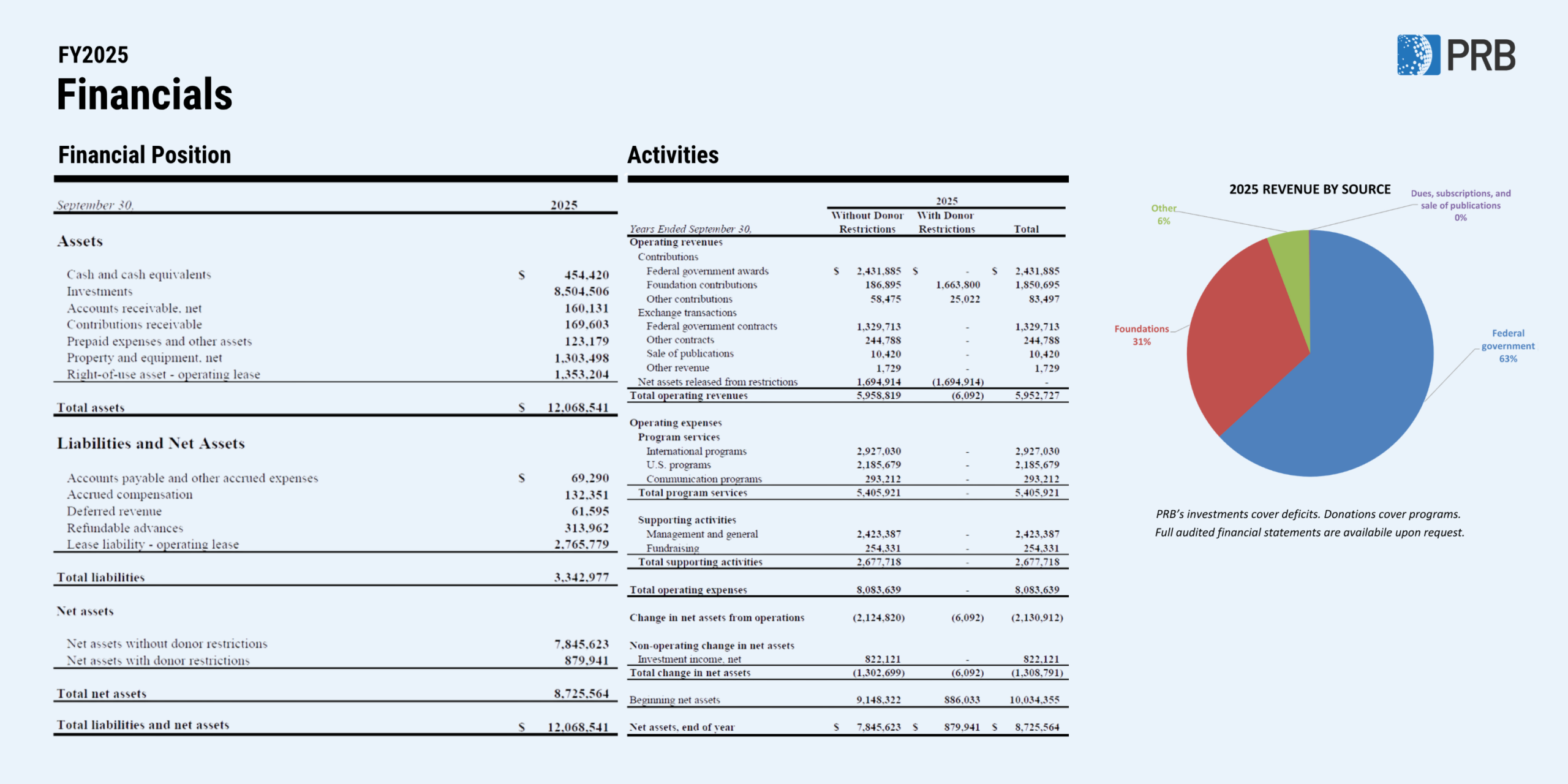
Financials & Donor Highlights
PRB is grateful to the many supporters who make this work possible.
Amref Health Africa
Ariadne Labs
Association of African Universities (AAU)
Brass Ring
Center for International Health, Education, and Biosecurity (CIHEB)
Education Sub-Saharan Africa (ESSA)
EngenderHealth
JSI Research and Training Institute, Inc.
Le Consortium régional pour la recherche en économie générationnelle (CREG)
LVCT Health
RENAFETS
The Counties of Mombasa, Kwale, Taita Taveta, Kilifi in Kenya
The Inter-University Council for East Africa (IUCEA)
The Palladium Group
Tetra Tech
Thomson Stenning
AARP
Andrew Carnegie Foundation (formerly Carnegie Corporation of New York)
Annie E. Casey Foundation
Appalachian Regional Commission (ARC)
Arnold Ventures
Association of Monterey Bay Area Governments (AMBAG)
California Department of Public Health (CDPH)
Conrad N. Hilton Foundation
Coordinating Center for the Centers on the Demography and Economics of Aging and Alzheimer’s Disease and Related Dementias, University of Michigan
Foreign, Commonwealth & Development Office (FCDO)
Georgetown University
International Development Research Centre (IDRC) with Global Affairs Canada
The Leadership Conference on Civil and Human Rights
Lucile Packard Foundation for Children’s Health
Merced County Association of Governments (MCAG)
Eunice Kennedy Shriver National Institute of Child Health and Human Development
Sarasota Institute of Lifetime Learning (SILL)
San Diego Association of Governments (SANDAG)
San Luis Obispo Council of Governments (SLOCOG)
Southern California Association of Governments (SCAG)
Tulare County Association of Governments (TCAG)
The David and Lucile Packard Foundation
UnidosUS
United States Agency for International Development (USAID)
William and Flora Hewlett Foundation
Juanita Tamayo Lott
Carol Devita
Clyde Phillips
Dr. Willie B. Lamouse-Smith
Jennifer Sciubba
John Haaga
Robert Crosnoe
Margaret Neuse Gift Fund
Marriner Eccles
Mr. And Mrs. Nihal W. Goonewardene Fund
| Adrienne Allison |
| Amy Mihelich |
| Andrew Mason |
| Angela Mertig |
| Annette Evans |
| Anthony Vadala |
| April Lackey |
| Carl Backman & Katherine Busch |
| Carolyn Lesesane |
| Charles B Nam |
| Chris Tarp |
| Chuck Darrah |
| Clifford B. Rimler |
| Constance Currier |
| Cristina Bautista |
| Curtis Cummings |
| David C. Finn & Katharine M. Harkins |
| Davrick Daniel |
| Dee Mowry |
| Dr. Richard Grossman |
| Edward Guay |
| Elizabeth Maguire |
| Frederick L. Bein |
| Geoff Dabelko |
| Gilbert Mendelson |
| Heather Sievers |
| James Rubenstein |
| Jeff Jordan |
| Jennifer Dowd |
| Jennifer Madans |
| Joan Kahn |
| Joanna Umo-Etuk |
| Jocelyn Popinchalk |
| John Casterline |
| John Christensen |
| John Grant |
| Jorge Garza |
| Joseph Lariscy |
| Judith Seltzer |
| Julie Caswell |
| Kenneth Haddock |
| Kofi Benefo |
| Kyler Sherman-Wilkins |
| Laurette Cucuzza |
| Lee Schoenecker |
| Linda Gordan |
| Lydia Pulsipher |
| Marcie Behm-Bultz |
| Margaret Snowden |
| Marianne Nnessen |
| Marilyn Fernandez |
| Mark A. Kaprelian |
| Martha Embry |
| Mary Weinberger |
| Michael Butz |
| Michael Kraft |
| Michael O’brien |
| Michael White |
| Michelle Behr |
| Nancy Bliss |
| Norman Moline |
| Osama Senousi |
| Peter & Nancy Donaldson |
| Peter Orville Way |
| Rhonda R. Smith |
| Robert Freymeyer |
| Robert J. Wyman Ttee & Guigui Yao Ttee-Wyman Living Trust |
| Robin Ikeda |
| Stephen Warren |
| Suthasina Chaolertseree |
| Suzanne Black |
| Terri Ann Lowenthal |
| Theodore Steck |
| Thomas Legrand |
| Valdemar Schultz |
| William Frey |
| William Holland |
| Yoonjoung Choi |
| Yun Junhyeok |
The Work Continues
Looking Ahead
2025 demonstrated the value in our years of steady work. When the questions PRB has long focused on became urgent, PRB was already prepared to act—with the evidence, the relationships, and the organizational agility. 2026 is where that momentum accelerates, because the work is far from done.
What this year made clear, and what guides the work ahead, is that demographic data are not a background consideration. Populations, and data about them, are the foundation on which sound policy, equitable resource allocation, and effective advocacy are built. PRB exists to make that foundation as strong and as widely accessible as possible. We are more committed to that mission now than we have ever been, and we are glad you are part of it.
Related Posts
Beyond the Headlines: As China and India Age, Young Africa Has Potential to Power Global Workforce
In this webinar, we examine data on the growth of sub-Saharan Africa’s working-age population and discuss its potential to power the global workforce.