167 Search Results Found For : "%EB%B6%80%EC%82%B0%EC%B6%9C%EC%9E%A5%EC%83%B5%E3%80%90Talk:Za31%E3%80%91%EC%8A%A4%EC%9C%84%ED%8A%B8%20%EC%B6%9C%EC%9E%A5%EB%A7%88%EC%82%AC%EC%A7%80%20%EC%88%98%EC%9B%90%EC%A0%84%EC%A7%80%EC%97%AD%2030%EB%B6%84%EB%82%B4%20%EB%B0%A9%EB%AC%B8"


Project: Demography and Economics of Aging and Alzheimer’s Disease

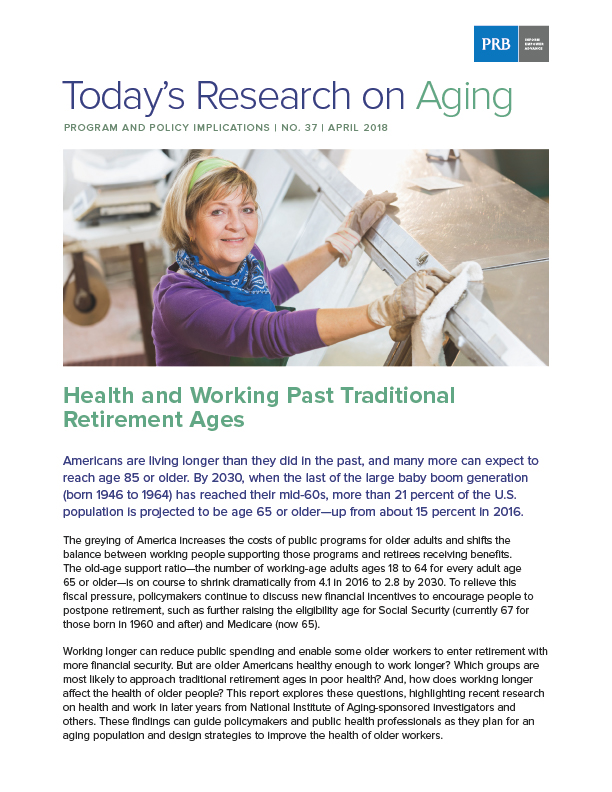
Today’s Research on Aging, Issue 37: Health and Working Past Traditional Retirement Ages

(2018) Americans are living longer than they did in the past, and many more can expect to reach age 85 or older. By 2030, when the last of the large baby boom generation (born 1946 to 1964) has reached their mid-60s, more than 21 percent of the U.S. population is projected to be age 65 or older—up from about 15 percent in 2016.

View Details Array ( [ID] => 3560 [id] => 3560 [title] => TRA_37_Health_Working_Past_Traditional_Retirement_Ages [filename] => TRA_37_Health_Working_Past_Traditional_Retirement_Ages.pdf [filesize] => 1007677 [url] => https://www.prb.org/wp-content/uploads/2018/04/TRA_37_Health_Working_Past_Traditional_Retirement_Ages.pdf [link] => https://www.prb.org/resources/will-more-baby-boomers-delay-retirement/tra_37_health_working_past_traditional_retirement_ages/ [alt] => [author] => 15 [description] => Today's Research on Aging: Health and Working Past Traditional Retirement Ages. Vol. 37 Published April 2018 [caption] => Today's Research on Aging: Health and Working Past Traditional Retirement Ages. Vol. 37 Published April 2018 [name] => tra_37_health_working_past_traditional_retirement_ages [status] => inherit [uploaded_to] => 3555 [date] => 2020-10-26 00:00:07 [modified] => 2020-10-26 00:01:25 [menu_order] => 0 [mime_type] => application/pdf [type] => application [subtype] => pdf [icon] => https://www.prb.org/wp-includes/images/media/document.png ) Download (1.0 MB)
Population Aging Impact Differs Across Countries

People are living longer and having fewer children, but the impact of this differs among nations.

View Details

Project: Demography and Economics of Aging and Alzheimer’s Disease

Effects of the Great Recession on Older Americans’ Health and Well-Being

This report summarizes recent research conducted by National Institute on Aging-supported researchers and others who have studied the effects of the recession on the health and well-being of older Americans.

View Details Array ( [ID] => 4328 [id] => 4328 [title] => TRA32-2015-great-recession-aging [filename] => TRA32-2015-great-recession-aging.pdf [filesize] => 121700 [url] => https://www.prb.org/wp-content/uploads/2020/11/TRA32-2015-great-recession-aging.pdf [link] => https://www.prb.org/resources/todays-research-on-aging-issue-32-effects-of-the-great-recession-on-older-americans-health-and-well-being-pdf/tra32-2015-great-recession-aging/ [alt] => [author] => 15 [description] => [caption] => Today's Research on Aging, Issue 32. Effects of the Great Recession on Older Americans’ Health and Well-Being [name] => tra32-2015-great-recession-aging [status] => inherit [uploaded_to] => 5829 [date] => 2020-11-17 15:35:59 [modified] => 2020-11-30 23:20:46 [menu_order] => 0 [mime_type] => application/pdf [type] => application [subtype] => pdf [icon] => https://www.prb.org/wp-includes/images/media/document.png ) Download (0.1 MB)

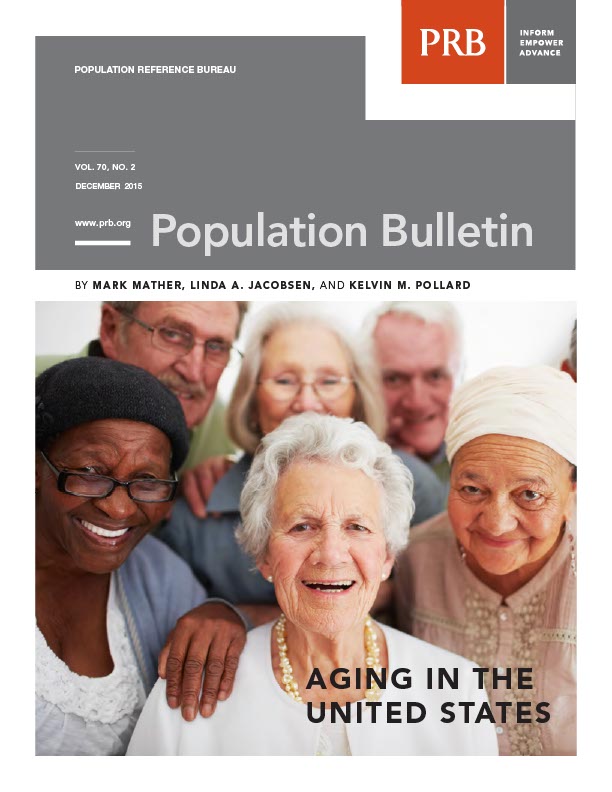
Population Bulletin, vol. 70, no. 2. Aging in the United States

(2015) Population Reference Bureau’s Population Bulletin, “Aging in the United States,” examines recent trends and disparities among adults ages 65 and older, and how baby boomers born between 1946 and 1964 are reshaping America’s older population.

View Details Array ( [ID] => 9916 [id] => 9916 [title] => population-bulletin-2015-70-2-aging-us [filename] => population-bulletin-2015-70-2-aging-us.pdf [filesize] => 2511247 [url] => https://www.prb.org/wp-content/uploads/2019/07/population-bulletin-2015-70-2-aging-us.pdf [link] => https://www.prb.org/resources/fact-sheet-aging-in-the-united-states/population-bulletin-2015-70-2-aging-us/ [alt] => [author] => 15 [description] => [caption] => [name] => population-bulletin-2015-70-2-aging-us [status] => inherit [uploaded_to] => 8886 [date] => 2020-12-27 01:52:46 [modified] => 2020-12-27 01:52:46 [menu_order] => 0 [mime_type] => application/pdf [type] => application [subtype] => pdf [icon] => https://www.prb.org/wp-includes/images/media/document.png ) Download (2.5 MB)

Which U.S. States Have the Oldest Populations?

While southern states are regarded as retirement magnets, eight of the 10 states with the highest percentages of older residents are not in the South. What’s driving these regional patterns?

View Details

Global Burden of Noncommunicable Diseases

(2012) Noncommunicable diseases (NCDs), also referred to as chronic diseases, are the leading causes of death worldwide.

View Details

Au Brésil, les politiques en matière de sida lient étroitement la prévention au traitement

(2005) En début février de cette année, le Brésil s'était, une fois de plus, presque arrêté de fonctionner à l'occasion de la célébration annuelle du carnaval. Pendant les quatre jours de réjouissances, des bénévoles associés à plus de 1 800 organisations non-gouvernementales (ONG) ont distribué plus de 11 millions de préservatifs, financés par le Ministère de la santé brésilien, en plus des 20 millions qui sont normalement distribués chaque mois.

View Details

Fiche de données sur la population mondiale 2010

(2010) De nombreux pays font face à une diminution de leur population en âge de travailler (généralement considérée comme étant les personnes âgées de 15 à 64 ans).

View Details

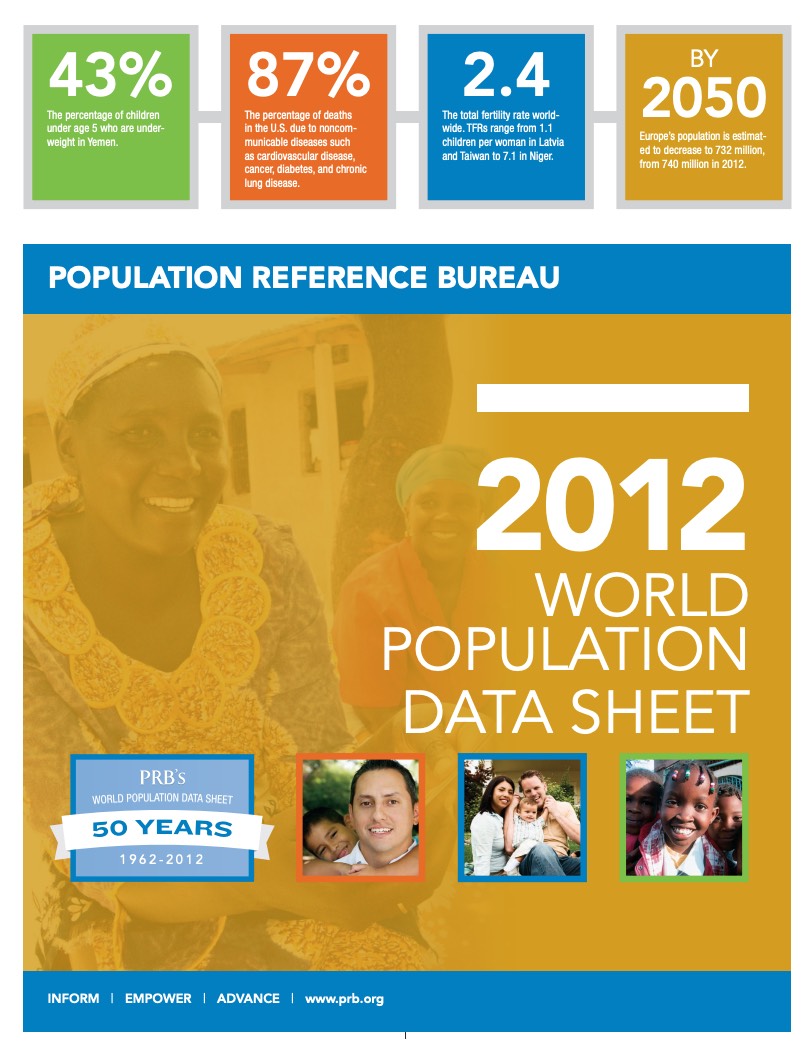
2012 World Population Data Sheet

Nearly all future population growth will be in the world's less developed countries, and the poorest of these countries will see the greatest percentage increase.

View Details Array ( [ID] => 15098 [id] => 15098 [title] => 2012-population-data-sheet_eng [filename] => 2012-population-data-sheet_eng.pdf [filesize] => 1405711 [url] => https://www.prb.org/wp-content/uploads/2012/07/2012-population-data-sheet_eng.pdf [link] => https://www.prb.org/resources/2012-world-population-data-sheet/2012-population-data-sheet_eng-2/ [alt] => [author] => 15 [description] => [caption] => [name] => 2012-population-data-sheet_eng-2 [status] => inherit [uploaded_to] => 5682 [date] => 2021-01-31 01:12:58 [modified] => 2021-01-31 01:12:58 [menu_order] => 0 [mime_type] => application/pdf [type] => application [subtype] => pdf [icon] => https://www.prb.org/wp-includes/images/media/document.png ) Download (1.4 MB)