
Supportive Budgeting Policies Can Make Africa's Growing Population a Powerful Engine for Economic Development
How smart budgeting can harness the demographic dividend

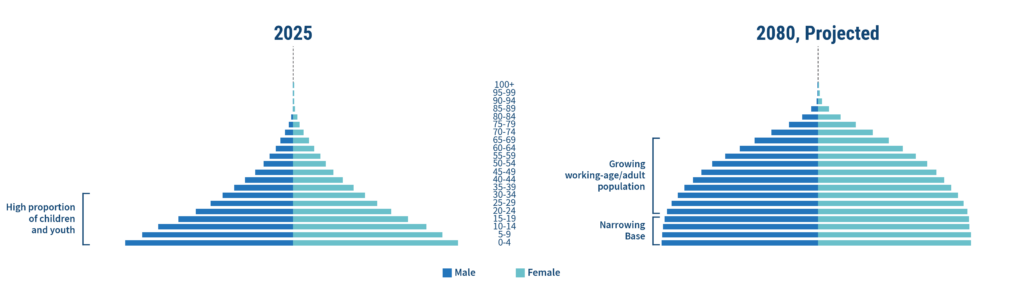
Africa is home to a rapidly growing population, with a large share of children and youth relative to the number of adults in the workforce. This demographic structure (see figure) means that many people are not yet able to contribute economically, yet the government must still make significant investments in education, health, and care to meet their needs. This scenario can place pressure on household finances—where needs may exceed income—and, at the national level, result in a gap between total consumption and production, limiting economic growth.
As today’s youth enter adulthood, sub-Saharan Africa is becoming a major driver of growth in the global working-age population (those ages 15 to 64). By 2100, sub-Saharan Africa’s working-age population is expected to represent 37% of the global working-age population, surpassing India (13%) and Europe and North America (10%).
Without adequate planning and investment, this dynamic can limit a country’s economic growth. But with the right policies, this youthful population represents a powerful opportunity for future development.
Figure. Sub-Saharan Africa’s Population, by Age and Sex
The Promise of a Demographic Transition
Already, young Africans are entering the working-age population healthier and better educated than previous generations of just 20 years ago. As fertility rates decline and the population structure evolves, the proportion of people in the working-age group increases relative to dependents (ages 015 to 64+).
Economic benefits do not automatically follow demographic change, however—they depend on supportive policies. This demographic shift—if accompanied by investments in education, health, and employment—can reduce the economic pressure on households and enable greater contributions to national growth.
The demographic transition refers to the shift from high fertility and mortality rates to lower ones, leading to the changes in the age structure of a population as described above. For African countries, this change could present a powerful pathway toward sustainable development, but only if it is harnessed strategically.
The Demographic Dividend
The favorable dynamics of demographic transition can lead to the rapid realization of a demographic dividend. This dividend refers to the economic benefit that may arise when a country has a relatively large proportion of its population in the working-age group due to declining fertility rates and the proportion of working-age people becomes significantly larger than that of their dependents. With fewer dependents to support, households and governments can potentially invest more in productivity, innovation, and economic growth, leading to the economic boom that has been seen in some Asian nations.
Although it is unlikely that Africa will see a full demographic dividend, there is the potential to achieve a transition that will be beneficial to the well-being and economies of families and nations.
Policies: The Key to Unlocking the Dividend
This potential will not be automatically realized. Capturing the benefits of the demographic transition depends on deliberate and sustained public investment in key areas:
- Health: to ensure a healthy, productive labor force.
- Education and skills training: to prepare young people for decent jobs.
- Gender equality: to empower women and ensure access to reproductive health services.
- Job creation and economic inclusion: to create meaningful employment opportunities for the working-age population and contribute to national growth.
The challenge lies in the sheer scale of resource mobilization needed. Current population growth rates mean that maintaining existing service levels will require substantial increases in public spending. Without strategic planning and optimal resource allocation, countries risk being overwhelmed by growing populations rather than benefiting from their demographic potential.
The African Union’s Vision
The African Union (AU) views Africa’s growing youthful population not as a challenge but as one of its greatest assets for economic transformation. It has positioned realizing the demographic dividend as central to continental development through its Agenda 2063: The Africa We Want vision and comprehensive roadmap. This strategic framework recognizes that harnessing Africa’s youthful population represents one of the continent’s greatest opportunities for transformation over the coming decades.
The vision emphasizes four critical investment pillars: 1) education and skills development, 2) employment and entrepreneurship opportunities, 3) gender equality and women’s empowerment, and 4) institutional accountability mechanisms.
It also acknowledges that demographic transition success requires coordinated public action and private sector dynamism. The gains from a demographic transition will not come automatically. Real progress requires:
- Evidence-based policymaking, grounded in national realities.
- Integrated investment strategies across education, health, labor, and finance.
- Strong public-private partnerships to drive job creation and innovation.
- Effective budget alignment to ensure that spending matches demographic priorities.
- Specific targeting of women and youth as key demographics whose empowerment will determine whether nations successfully capture their demographic dividends.
From Vision to Action
A demographic dividend cannot be realized without a fiscal framework that reflects population realities.
The shift from producing strategic documents to implementing actionable, well-financed reforms remains a challenge. National governments must embed demographic considerations into budgeting processes to improve both the efficiency and equity of public spending.
High population growth means that maintaining current service levels requires massive increases in public spending—in schools, health systems, and infrastructure. The transition is not only about reducing fertility but also adapting and scaling services to match a dynamic population structure.
Without strategic planning, evidence-based budgeting, and targeted investments, countries risk being overwhelmed—unable to convert population growth into inclusive prosperity. The AU roadmap sets a strong vision for capturing the demographic dividend, but this vision alone is not enough—countries need operational tools to translate that vision into budget decisions.
A Critical Policy Tool
To help African governments make evidence-informed budgeting decisions that would support their countries through a demographic transition, the Regional Consortium for Research in Generational Economics (CREG) developed the Demographic Dividend-Sensitive Budgeting (DDSB) and the Demographic Dividend Development Index (DDMI). These innovative tools represent a collaboration between African governments and researchers to transform how African nations allocate public resources and align public spending with demographic priorities.
Standard budgets allocate spending in traditional ministry-based categories, which often miss key economic realities like unpaid care work, household financial burdens, and the long-term benefits of investing in family planning and education. The DDSB and DDMI tools correct that gap and support evidence-based budget planning that allow lifecycle costs, intergenerational support, and macroeconomic gains to be modeled and linked to budget decisions.
Tools like the DDSB are needed because the demographic dividend is a potential, not a guarantee. It provides African countries with an evidence-based framework for managing their finances strategically, ensuring that every public expenditure contributes effectively to transforming a country’s youthful population into a powerful engine for inclusive and sustainable economic development. These tools empower governments to turn vision into action using data they own and policies they define.
Related Posts
Unlocking Africa's Future
How smart budgeting can harness the demographic dividend

A New Tool Helps African Countries Budget for Demographic Change
Mali’s experience with Budgeting Sensitive to Demographic Dividend

From Research to Policy: Why the NTA Africa Conference Matters Now
Conditions for policy change will be shaped at the annual meeting in Saly, Senegal.