(March 2011) Past research has extensively explored racial and ethnic disparities in health insurance coverage in the United States and found wide differences in the composition of the uninsured populations.
(2013) In Zambia, girls often start childbearing before they are 18 years old, and many women end childbearing after the age of 35 (see Figure 1).1 This long period of childbearing contributes to Zambia's high total fertility rate, or average number of children per woman, which at 6.2 is one of the highest in sub-Saharan Africa.
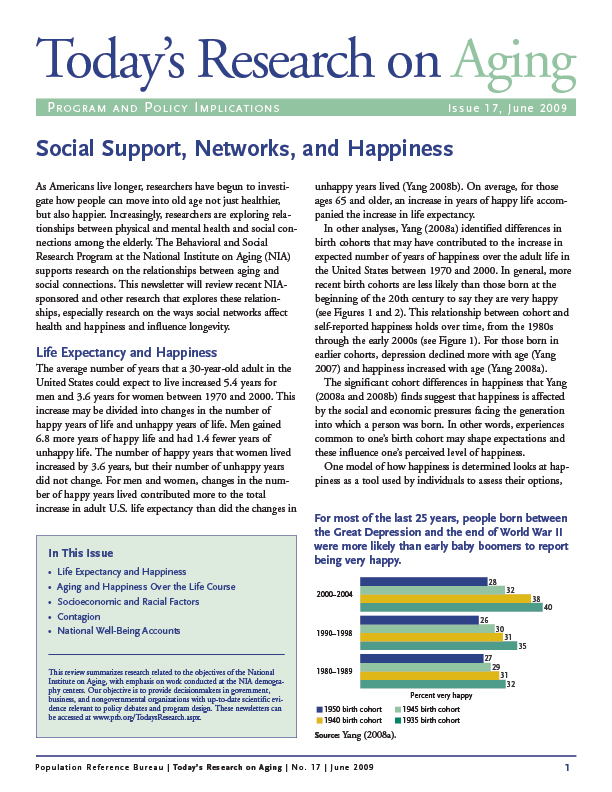
As Americans live longer, researchers have begun to investigate how people can move into old age not just healthier, but also happier.
View Details
Array
(
[ID] => 4343
[id] => 4343
[title] => TRA17-2009-aging-happiness
[filename] => TRA17-2009-aging-happiness.pdf
[filesize] => 604992
[url] => https://www.prb.org/wp-content/uploads/2020/11/TRA17-2009-aging-happiness.pdf
[link] => https://www.prb.org/resources/todays-research-on-aging-issue-17-social-support-networks-and-happiness/tra17-2009-aging-happiness/
[alt] =>
[author] => 15
[description] =>
[caption] => Today’s Research on Aging, Issue 17, June 2009
Program and Policy Implications
Social Support, Networks, and Happiness
As Americans live longer, researchers have begun to investigate how people can move into old age not just healthier, but also happier. Increasingly, researchers are exploring relationships between physical and mental health and social con-nections among the elderly. The Behavioral and Social Research Program at the National Institute on Aging (NIA) supports research on the relationships between aging and social connections. This newsletter will review recent NIA-sponsored and other research that explores these relation-ships, especially research on the ways social networks affect health and happiness and influence longevity.
This newsletter reviews recent NIA-sponsored and other research that explores the relationships between aging and social connections.
[name] => tra17-2009-aging-happiness
[status] => inherit
[uploaded_to] => 9065
[date] => 2020-11-17 15:37:23
[modified] => 2020-12-21 00:00:34
[menu_order] => 0
[mime_type] => application/pdf
[type] => application
[subtype] => pdf
[icon] => https://www.prb.org/wp-includes/images/media/document.png
)
Download
(0.6 MB)
(2013) Despite more funding for health services during the past decade (per capita health spending rose from US$21 in 2000 to US$45 in 2009), India is unlikely to reach the targets for the health-related 2015 Millennium Development Goals (MDG).1